

The third floor of a five-story office building in Victoria Island loses power two or three times a week. Someone has to reset the breaker and work continues as usual. No one on the floor makes the connection to the burning smell near the distribution board or the two split units added to the floor a quarter ago. When an electrician does take a look, he finds the terminal has discolored and the insulation of the outgoing cable has started to harden.
Faults in the electrical system often get worse and lead to bigger issues. A tripping circuit breaker is often the visible symptom of overloading or a deteriorating connection, and if it is ignored, the same condition can become a fire risk. Planned maintenance is designed to identify these issues before they become a bigger problem.
Electrical Problems are Often Hidden
Before a major breakdown of an electrical system, a series of smaller electrical failures happen. Terminations slowly get loose as the wire expands and contracts with the load, and gets even looser due to vibrations from equipment on an industrial plant. Each small rise in resistance produces extra heat at the joint, which speeds up corrosion and loosens it further.
Insulation follows the same pattern of failure. Moisture and chemicals in the air speed up the degradation of the cable insulation, and so does the humidity and salt air of Lagos.
This doesn’t necessarily stop the supply. A distribution board can keep delivering power with a failing busbar connection for months, so a working system is not proof of a healthy system. Nuisance tripping, flickering lights, an abnormally warm panel cover or a burning smell near switchgear are not things to ignore. These are signs to call a qualified electrician.
What Planned Electrical Maintenance Actually Involves
A thorough programme includes scheduled inspections, tests, servicing and corrective work, and records the results. Each of these stages helps to inform the next.
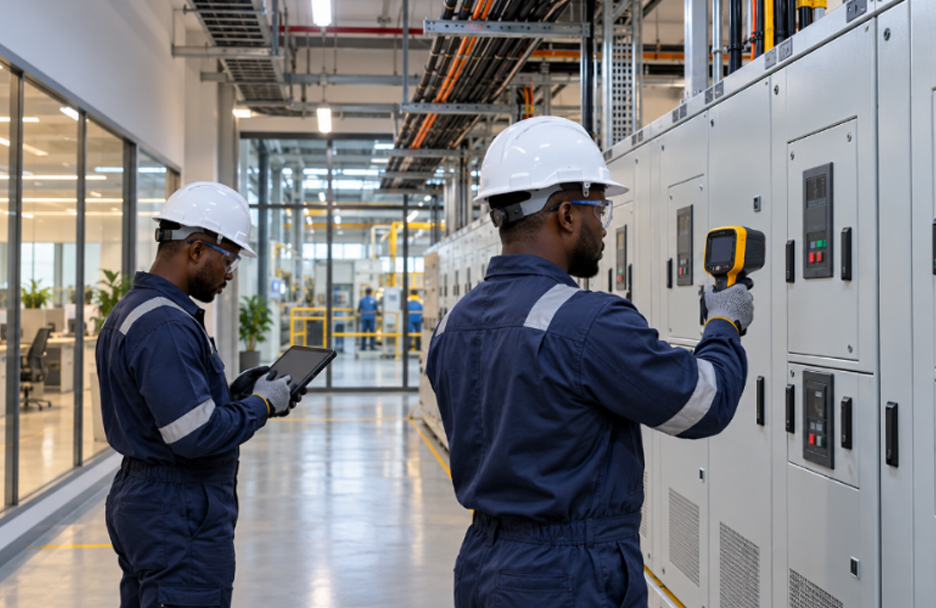
Inspections look for things like discolouration, corrosion, damage to insulation, and signs of overheating. Testing helps determine what the human eye can’t. This includes insulation resistance testing, verification of earthing and bonding, protective device testing and thermographic surveys to detect hot joints under load.
Distribution systems, including circuits and phases, may be overloaded and stressed beyond design limits. Load monitoring can help identify if circuits and phases are operating as designed or if they are being overloaded. This work can only be performed by qualified and competent personnel who follow safe isolation and permit to work procedures.
Thermographic surveys can help identify faults and abnormalities, however this often requires panel covers be removed while the equipment is still live.
Findings then become corrective actions with owners and target dates. This is the real difference from reactive maintenance, which begins only after something has failed.
Why Offices and Industrial Facilities Need Different Maintenance Approaches
Electrical maintenance for commercial buildings focuses mainly on lighting, air conditioning, lifts and IT. Electrical demand often peaks in the afternoons, when cooling plant runs hardest. UPS systems and the boards supplying server rooms and security systems are the more critical systems.
Industrial sites are by no means uniform. For example, a fabrication workshop and a cold store have a completely different load profile, especially if the cold store is a 24/7 operation. Many of the motors and drives operate continuously and leave little or no time to isolate circuits, while starting currents and harmonics cause stresses on cables and switchgear that an office never experiences. Industrial electrical maintenance services therefore need to fit production schedules, with shutdown work agreed well in advance.
For both facilities, one question helps set maintenance priorities: if this circuit failed at 10 a.m. on a Tuesday, what would stop, and for how long?
Lowering Unplanned Equipment Failure and Breakdown
A telling example of the importance of regular industrial electrical maintenance is a conveyor motor that starts drawing increased currents due to a damaged bearing. Industrial electrical maintenance services that incorporate load and thermal checks may pick up the change weeks before the protection trips or the windings burn out. A bearing replacement during a scheduled stop is far less costly than rewinding the motor during unplanned downtime.
In offices, early failures of air conditioning compressors are often caused by the electrical side of the HVAC system, which may also include loose contactor terminals and undersized cables. Therefore, in the HVAC system, as much attention should be paid to the electrical side as to the refrigeration side.
Preventive work can not anticipate every failure. Some components suddenly and without warning, fail, while some faults develop between preventive maintenance inspections. The objective of preventive maintenance is to shift a meaningful proportion of failures from unplanned to planned.
Electrical Safety and Risk Management
Damaged cables, poor connections, and overloaded circuits, are common causes of electrical shocks and fires. Fuses and circuit breakers are the last line of defence in a circuit. They need to be tested to be sure they are working. Earthing also needs to be tested to confirm it is functioning properly.
Only qualified electrical personnel, using safe isolation, lock-out/tag-out and suitable PPE, should work on electrical equipment. Other staff should report problems, keep access to electrical panels clear and never open or reset equipment showing signs of burning. Choosing an electrical maintenance company in Nigeria that documents its safety procedures is part of managing this risk.
Managing Generators and Backup Power Systems
Most buildings in Nigeria use more than one power supply system. Buildings often change from utility supply to a generator and back several times a day. Frequent changes stress the switching equipment.
Automatic changeover and transfer switches need their contacts and control wiring checked as well as their timing relays. The connection between the generator output terminals and the cables need to be checked as well. These checks should be done alongside engine servicing, which is often handled by a different team. UPS batteries degrade with heat and age, and protection settings that suit the grid supply may behave differently on generator power. Keeping the backup systems in the same plan as the main distribution avoids breaks between different contractors.
Building a Useful Electrical Maintenance Schedule
There is no single ideal inspection interval for all types of equipment. A sensible maintenance schedule is made up of manufacturer’s recommendations, conditions of the equipment, findings from previous inspections, how critical the equipment is to the operation, environmental conditions and history of equipment failures, compliance with safety and other regulatory requirements and lastly, how the equipment is used.
Monitoring and tracking helps in implementing the schedule. Inspection reports help to identify which pieces of equipment need to be serviced more often, whether recommended repairs were completed, and where the budget should be spent. When comparing providers of electrical maintenance services in Lagos, find out how findings are reported and if they are assisting clients in tracking action items.
How Provast Limited Supports Building Maintenance
Provast Limited has been operating as a facility management and electrical maintenance company in Nigeria since 1997, serving residential, commercial and industrial buildings. Its listed services include electrical installations and maintenance, management of diesel generating sets and air conditioning units, among others, delivered through its integrated facilities solutions alongside its property management services.
Because there are inter-dependencies between electrical work, servicing of generators and maintenance of HVAC systems, it makes sense to have them all consolidated in a single plan. Provast does offer electrical maintenance for commercial buildings as part of a wider planned preventive maintenance contract, and not as a series of reactive call-outs.
Conclusion
Planned electrical maintenance is an ongoing responsibility, and takes into consideration the natural ageing of electrical systems. It addresses the ageing by measuring and managing it, as opposed to a reactive approach which assumes that failures of electrical systems will be discovered at some stage, and perhaps unexpectedly. The aim is to take appropriate actions to mitigate the risks in a timely manner.
Do you need electrical maintenance services in Lagos for your office or industrial building? Contact Provast Limited for a range of planned preventive maintenance solutions as well as other facility management services.
Frequently Asked Questions
How often should the electrical systems in an office be checked?
There is no standard interval. The best practice is for intervals to be determined by how equipment is aging, how important the equipment is to the business, the environment in which it operates, and what the law requires. Many buildings have a routine visual check combined with a more in depth testing, and adjust intervals based on the results of the tests.
What is the difference between preventive and reactive maintenance?
Reactive maintenance is done after a failure has occurred. Preventive maintenance, on the other hand, is done to mitigate risks before they become greater. Risks may be discovered during routine inspections and tests. A plan is then developed to take appropriate actions in the future to mitigate the risks.
What do industrial electrical maintenance services typically include?
This varies from site to site, but often includes motors, motor control centers, variable speed drives, control panels, switchgear, distribution systems and earthing. Most work is scheduled during planned production shutdowns.
Does electrical maintenance for commercial buildings include backup power?
It should, if backup power systems are in place. Safety and the reliability of the supply are of primary importance, and are affected by the design and operation of automatic transfer switches, changeover panels, generator connections and uninterruptible power supply (UPS) systems.
What are the main things to consider when selecting an electrical maintenance company in Nigeria?
You should look for a company that employs qualified personnel, and has documented safety procedures and an effective, closed-loop, system for corrective actions. It is also beneficial if the company has the capability to manage the electrical work in conjunction with generator work, HVAC and other services in the building.
Can a thermographic survey replace other electrical tests?
Thermography assesses the condition of electrical systems and circuitry by measuring abnormal heat buildup, but it does not evaluate insulation condition, earthing integrity or protective device performance. Thermography can and should be used in conjunction with other electrical tests.