

An office in Victoria Island has employees that work through lunch, leaving little time to clean up and clear out food waste from the kitchen. Over time, a film of food and grease builds up behind and under office appliances. The staff is so large that it’s easy for someone to miss that film. Soon, employees begin to see cockroaches around the sink. Someone tries to take care of the problem, often with temporary fixes, like aerosols, that stop the sightings for a period of time, and the problem returns.
This is the case for the majority of workplace pest problems. The cockroach is the visible part of the problem. The real part of the problem is food waste and other waste left behind, along with openings around pipework and an unmanageable waste management system, and unless those are dealt with, any treatment is only temporarily solving the problem.
Commercial Buildings and Pests
Offices and other commercial buildings provide food, water, and shelter for pests. Staff lunch and tea breaks, along with shared water coolers and kitchens, provide food. Moisture is provided by dripping pipes, AC condensate lines, and slow drains. Shelter is provided by storage areas, false ceilings, and cable trays.
Even buildings that are otherwise clean and tidy provide points of entry for pests. Cockroaches and ants arrive in delivery cartons. Rodents use drainage and utility pipes for entry. Flower beds, standing water in gutters, and other areas near the building provide hiding and breeding places for pests.
Each property has its own pest issues. An office tower with a staff restaurant will likely have cockroach and rodent problems more so than a small consultancy suite. A property with timber fittings close to the soil will likely have issues more with termites. Understanding commercial pest control in Lagos means starting with an understanding of the property in question and not with a pre-defined checklist.
Pest Problems Can Become Operational Disruptions
Most calls for office pest control Lagos facility teams make start with a few cockroaches in a kitchenette. That usually doesn’t disrupt work. Disruption usually happens when activity spreads to something people depend on.
Rodents can gnaw on cable insulation in ceiling voids and comms rooms. Rodents can also spoil paper records and pantry supplies. Termites will feed on door and window frames as well as skirting boards, cupboards and office files. Not all infestations mean the structure of the property will be compromised, but repair may be needed.
Ants can be a nuisance but trails to staff tuck shop sugar can be irritating. Mosquitoes can be an issue for those working in the facility at night.
Problems Can Be Identified Through Routine Inspections
Because cockroaches are mostly nocturnal, a cockroach on a desk at midday usually means a population has outgrown its hiding places. Rodents will also avoid people, so rodents seen in daylight can point to an established population.
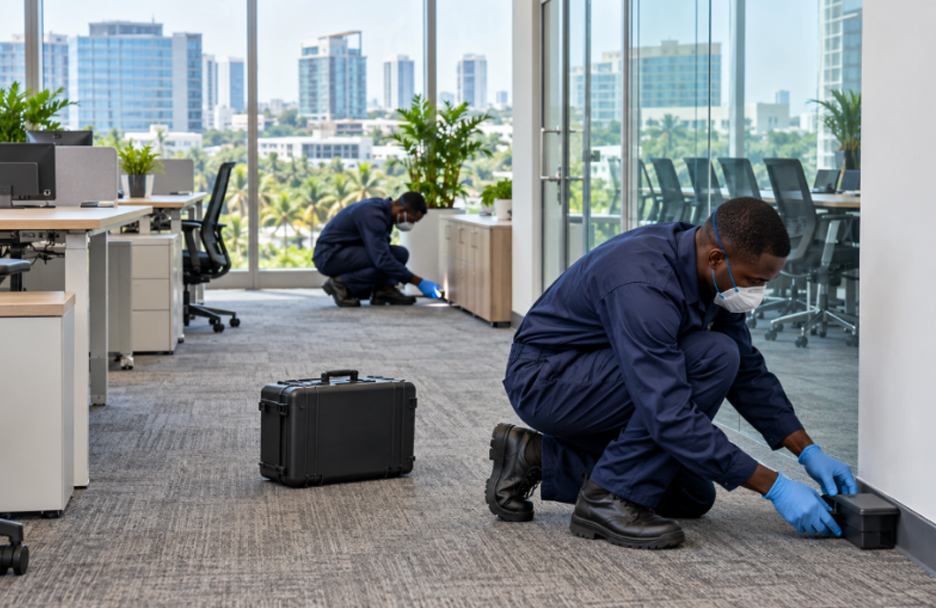
The aim of routine inspection is to detect activity at earlier stages. Kitchens, bin stores, loading bays, drains, and storerooms are routinely checked by a technician for droppings, gnaw marks, egg cases, mud tubes, and damaged packagings. Monitoring devices placed at recorded activity locations reveal whether an infestation is increasing or decreasing.
Inspection reports are worth requesting when comparing office pest control Lagos service providers. Accumulated findings shed light on whether a loading bay or tenant space is constantly inviting pests.
Prevention is More Effective Than Cure
Using chemicals to treat pests gives temporary relief but doesn’t address the root cause of infestation. An integrated approach of the following workplace pest prevention measures stops pest infestation.
- Waste Management: Implementing a waste management system that includes covered bins, regular removal and clean bin stores away from entrances, removes the food sources that draw pests into the premises.
- Cleaning and Sanitation: A deep clean of hard-to-reach areas behind appliances and drains, and along the floor edges, stops food and moisture buildup which are the main sources of pests.
- Sealing: Preventing pest entry through gaps and holes is equally as important.
- Moisture Control: Leaking and blocked pipes, gutters and drains should be repaired to avoid moisture buildup, which is a main source of pests.
- Food Storage: Pests are attracted to food. Establishing a policy on food kept on desks and using sealed containers stop food buildup.
- Monitoring and Follow-up: Pests may return and be hidden in treated areas. The approach must be rechecked and plans adjusted accordingly.
Each preventive measure covers a weakness in the other measures. Proofing without a waste management system allows already entered pests to multiply, and a deep cleaning without proofing allows new pests to enter.
This is the thinking behind Integrated Pest Management (IPM), a preventive and proactive strategy which coordinates the use of various approaches and methods like inspection, identification, prevention, monitoring and if necessary, treatment. Unlike the old approach where personnel would spray an entire office, with the new approach, personnel would selectively treat only the infested area as stipulated on the label.
Protecting Employees and Visitors
Employees who have seen cockroaches in the kitchen stop using it and begin keeping food in desk drawers. A mouse spotted in reception creates a poor first impression and reflects badly on the entire organisation.
Good commercial pest management also requires consideration of the people using the building. If possible, the vacated areas should be treated in the evening or on weekends, and treated areas should not be reoccupied until it is safe to do so, as per the label or recommendation of the technician.
How often should a building be treated?
No single schedule fits all buildings, and routine monthly spraying is justified only in limited cases. The determination should be based on pest activity and infestation history, the type of building, what goes on in the building, food handling and storage, occupancy, environmental conditions, regulatory and/or tenancy requirements.
It is important to distinguish inspections from treatments when it comes to commercial pest management. A building may require monitoring checks on a monthly or quarterly basis, while treatment is carried out only when necessary, based on the findings. Generally, a canteen will require more frequent monitoring than a barely used office floor. Any workplace pest prevention plan should be evaluated whenever the use of the space changes.
The Role of Professional Pest Management
Correct identification determines the approach. Treating termites is entirely different from treating ants. A professional provider confirms the pest, locates the source, suggests proofing and housekeeping changes, and selects the best treatment.
Reliable business pest control services also keep records: Site plans showing monitoring locations, visit reports, treatments used and actions taken. Continuous reactive call outs, (where treatment is done after complaints) tend to result in the situation described at the beginning of this article.
How Provast Limited Supports Commercial Property Maintenance
Provast Limited offers facilities management and building maintenance for residential, commercial and industrial properties in Lagos. Pest management is combined with other building services (i.e. janitorial services, security, property management) to give a more integrated service.
It is important to understand that pest problems rarely constitute a stand-alone service. A leaking pipe is a maintenance problem and an overflowing bin store is a housekeeping problem. There may be gaps behind kitchen units that may only surface during a routine inspection. It is during such inspections that the management of a building should integrate facilities management with commercial pest management.
For more information, see Provast’s articles on pest control for commercial establishments in Lagos and the different types of pests in Lagos.
Conclusion
Moisture, poor housekeeping, open access and gaps in structural integrity can all contribute to pest problems in commercial buildings. Activity is often localised and can be caught early and treated as needed with regular building inspections. From a building management perspective, the best approach to commercial pest control in Lagos is to integrate pest management as part of an overall building management strategy as opposed to a one-time or emergency service.
Do you require reliable and professional business pest control services for your commercial property in Lagos? Contact Provast Limited for more information.
Frequently Asked Questions
How often should an office building undergo pest control?
It’s hard to determine how often to treat an office building, as it depends on pest history, occupancy and how the building is used. Many office buildings, however, can benefit from routine inspections, with pest control treatments only administered based on findings.
Is it safe to be in a building during a pest control treatment?
Not always. Staff should not enter treated areas until the pest control product label or the technician confirms it is safe, which is often why pest control treatments occur outside of business hours.
What kinds of pests are found in Lagos offices?
Cockroaches and ants are common in pantries and kitchens, rodents are often found in storerooms and ceiling voids, and mosquitoes are found near standing water. Termites can be a concern if there is susceptible timber.
What can the workforce do to help with workplace pest prevention?
The best way to help is by practising good hygiene and tidiness around the office. Remain diligent and report any leaks or drips to the facilities team. Let the team know immediately if you spot any rodent droppings or gnaw marks.
Can shop bought insecticides work?
In the short term, insecticides can kill insects. The spray will not, however, find nests and other entry points. To resolve pest issues, the best option is to hire a professional office pest control Lagos service. The service will examine your office and provide advice and treatment for potential pest issues.
What should business pest control services offer?
The service should provide an initial assessment of your office, identify the pest, provide advice for proofing and housekeeping, and treat the infestation, if any. The service should give you a report of the visit, and offer follow-up visits.